So What the Fudge is SEO, Anyway? Do I Need It?
SEO is a buzzword that’s no longer new, but has such a shifting definition that it can still be mysterious. You’ve been told that SEO is vital to your web presence, that it impacts rankings from search engines like Google, that it’s important to include in any website. But what is it, and what, exactly, does it do for your business?
SEO stands for Search Engine Optimization, and it is a wrapper term for everything your website designer and marketing manager do to get your website playing well with search engines. A short description would be “Stuff you do to boosts your search rankings”. Want to come in fifth in a search result instead of 105th? Look to SEO.
If you think of SEO as a branch of marketing, you’ll get a fair idea of where it sits in your hierarchy of need. Just like marketing, there are levels to SEO, depending on how aggressively you want to push your online presence. I break SEO down into three tiers when I talk to clients, each tier having its own goals and methods.
Basic SEO: Good Hygiene. I Recommend for Everyone.
The first tier of SEO is what I usually characterize as “good hygiene”. I put everything that’s central to the initial design of your site in this tier. When you used to talk to web designers and marketing managers 10 years ago, this is what they’d be talking about when they brought up tools like key words and load time. I do a lot to ensure SEO when designing a website, including:
Making sure the URL is sensible and relevant. No weird URLs that don’t include the business name, or have a lot of numbers or letters at the end. URLS that are logical to people are logical to search engines, and will get relevant hits in online searches. Your URL is your first opportunity to use keywords.
Making each slug is sensible and relevant. For example, if you were making a website for Geordi La Forge, his website might be “geordilaforge.com”, and his blog page would be “geordilaforge.com/blog”. His online shop would be “geordilaforge.com/shop”. Everything after the “.com/” is a page’s slug, and this is your second opportunity to use keywords. You would not want to see a page URL like “geordilaforge.com/home2” or “geordilaforge.com/XY29URM”. These make sense to neither people nor machines.
Setting up an SSL certificate. This is a digital certificate that authenticates the identity of a website and enables an encrypted connection between the web server and a browser. SSL stands for Secure Sockets Layer (which even I honestly never remember), but is more frequently called a Public Key Certificate. You can tell immediately if a website has an SSL certificate by whether the URL starts with “http://” or “https://”. The “s” in “https” tells you that a website is secure. Search engines recommend websites that are secure, and punish websites that are not secure.
Writing a description for every page that includes keywords. Search engines will use these summaries in actual search results, so this serves double duty in making a catchy and clear description for real-world users, and by putting keywords into the description that search engines are looking for to increase the likelihood that your page will come up in search results. In fact, the only time your users will see these page descriptions is in search results – they won’t see descriptions on the website itself. This is all behind-the-scenes.
Having clear navigation links and using “Call To Action” links so that pages on the website point to each other. For example, having a button right on the body of the home page for “Contact Us” or “Shop With Us” can both push users to their high priority pages, and to provide a level of “deep linking” in your website, where pages point to each other, which reinforces your structure.
Having a clearly organized sitemap, and sharing that sitemap with Google Console, which improves your search rankings immediately. Keeping your site free of broken pages and broken links is basic hygiene, both for SEO and just for website design. This includes accurate contact information and social media links.
Including Alt Text in all images on websites, especially images that impart any information. This is another area to include keywords, and also is required to be ADA compliant. Users who rely on screen readers cannot get information from an image alone – these images need descriptions, or alt text, which a screen reader will pick up and read aloud. Like descriptions, alt text is invisible for most of your users and lives behind-the-scenes. Alt text is crucial for any customer-facing business, as it allows users with screen readers to effectively navigate your site, increases the opportunity for including keywords, and also protects businesses from discrimination lawsuits.
Keeping text on the website clear and concise. Your last – and perhaps most obvious – opportunity to use keywords is in the actual text on your website. The more relevant the content on your website is to your business and your customers, the more keywords it will have, naturally. If you run a bakery and you spend one paragraph talking about baking and gluten-free options, that will be much stronger, key-word wise, than five paragraphs about a company off-site and the revelatory power of the northern lights. Targeted, relevant text that gets your user where they’re going also makes your priorities clear to a search engine.
Managing load time. A fast website is an optimized website, and search engines do care about load time. I manage this by keeping image file sizes reasonably small, and not adding a lot of unnecessary transparency or animations. This is always a moving target, as load times get faster and faster, and designers have increasingly flexibility here to make more elaborate, image-centric designs. If you think back to websites in the 1990s and early 2000s, they were text-heavy, and started using “flat design”: buttons with no shading or contours, flat icons instead of illustrations. A big reason this type of design became popular was because it was fast to load. While I still like the clean lines of flat design, there is a more latitude to include larger pictures and overlays on websites that can really add to the design – while maintaining a quick page load time. For humans, the rule of thumb is that a page should absolutely load in under 3 seconds. Faster is better. There are services that provide local caching for big, image-heavy, traffic-heavy websites like National Geographic or NASA that just can’t get around their file size but still need to be snappy. I haven’t yet needed to engage with these services, but they do exist.
This level of “good hygiene” SEO, I consider to be non-optional. These are the basics that any well designed website needs to come away with in order to be set up correctly for search engines. I include all of these services in my web design, and I would expect this of anyone creating a website.
Next Level Up: Website Maintenance. I Recommend for Businesses Who Need to Inform Users, or Who Rely on a Web Presence for Growth.
The second tier of SEO is website maintenance. A search engine can’t promote a website that’s broken or that has expired. Tracking your website on Google Analytics and internal analytics like Squarespace Analytics will show traffic and other critical metrics, alerting you to any issues that may arise, as well as helping you spot behavioral trends that can inform marketing efforts.
Along with checking that your website remains in working order, keeping a calendar or news page maintained can boost SEO in two ways: First, it gives your users something to keep coming back for and engaging with, which gives you a natural boost to traffic. Search engines like websites that people like, so this both helps keep your users engaged, and also naturally boosts your results.
Secondly, there was a change some years ago in how Google ranks websites, and other search engines have followed suit. Google weighs website growth in their search results. This means that it shows a preference for websites that are continually producing new content. Sites like shops, blogs, archives like Wikipedia and YouTube, social media platforms, and academies like Coursera and Udemy do this natively as growth is part of their design. This is not a core pillar of all websites, and in the case of sites that might be just an informational landing page for clients, this type of growth may sit outside core content.
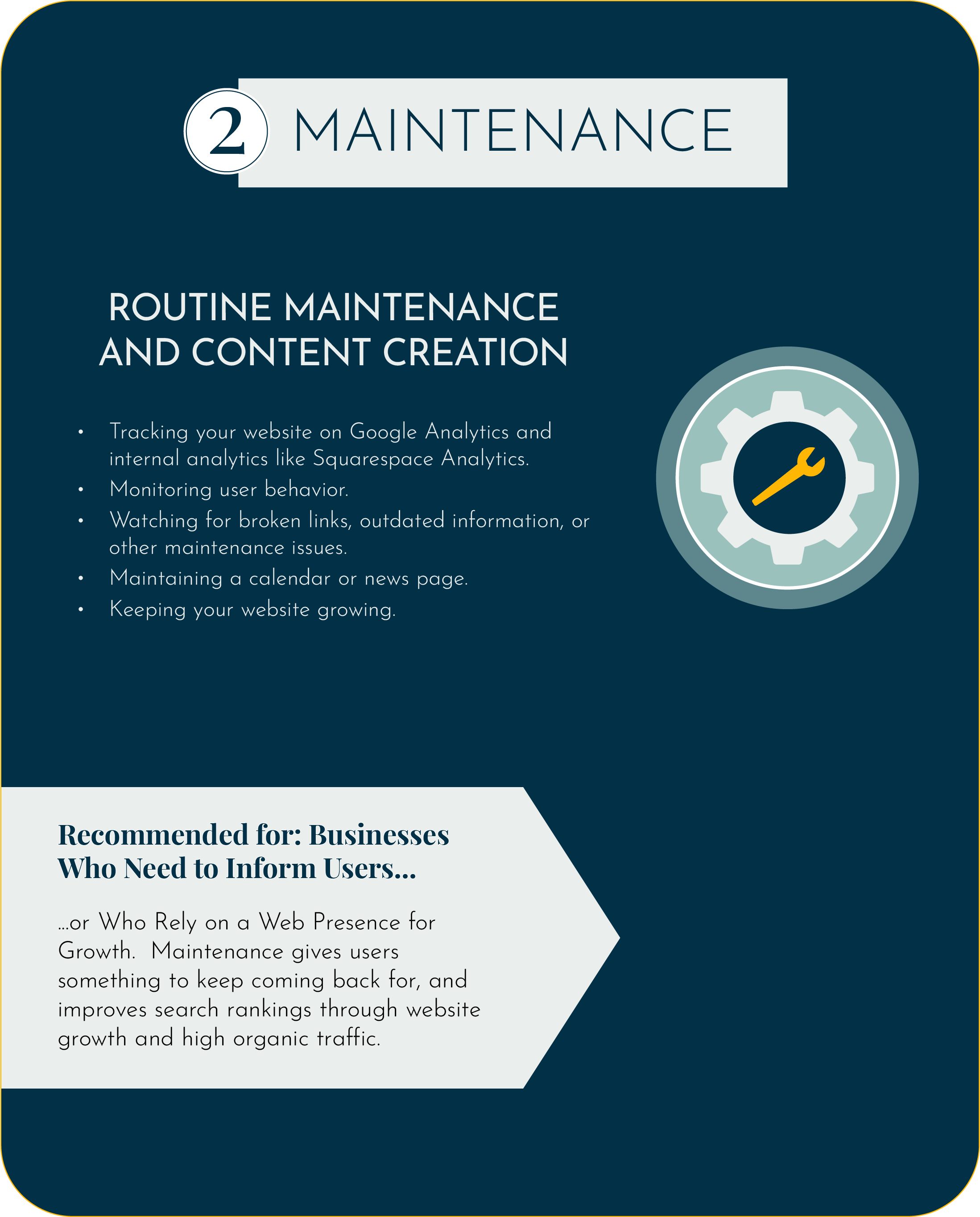
ROUTINE MAINTENANCE AND CONTENT CREATION
Tracking your website on Google Analytics and internal analytics like Squarespace Analytics. Monitoring user behavior. Watching for broken links, outdated information, or other maintenance issues. Maintaining a calendar or news page. Keeping your website growing.
Recommended for: Businesses Who Need to Inform Users, or Who Rely on a Web Presence for Growth. Maintenance gives users something to keep coming back for, and improves search rankings through website growth and high organic traffic.
I recommend this level of SEO management for any business that relies on a web presence to discover and connect with users and clients, and for businesses that want to keep in touch with their users on business events and milestones. Maintaining a calendar and a blog may be critical to communicate with your users, and that will only help with SEO.
I offer maintenance packages that provide support for this kind of maintenance. This level of engagement will always require input from the business itself, as well.
Highest Level: SEO as Marketing. I Recommend You Speak to a Marketing Strategist.
The third tier of SEO gets into social media campaigns, deep linking, key word testing, and routine blog posts that may have very little relevance to immediate business news. This type of SEO management relies on the above-mentioned premise that search engines reward growing websites with higher rankings. The marketing strategy, therefore, is to keep creating content, frequently and continuously.
If in the past 10 years, you’ve had marketing agencies or SEO agencies recommend that you keep publishing blog pages and don’t worry about the quality of the content – this is why. There is a school of thought that just posting and posting and posting increases your reach. This is not inaccurate, but I have yet to hear a business that started a blog campaign and then have a meaningful lift. Always consider your marketing strategy as a whole, and where SEO fits into the galaxy of your marketing plan and company goals.
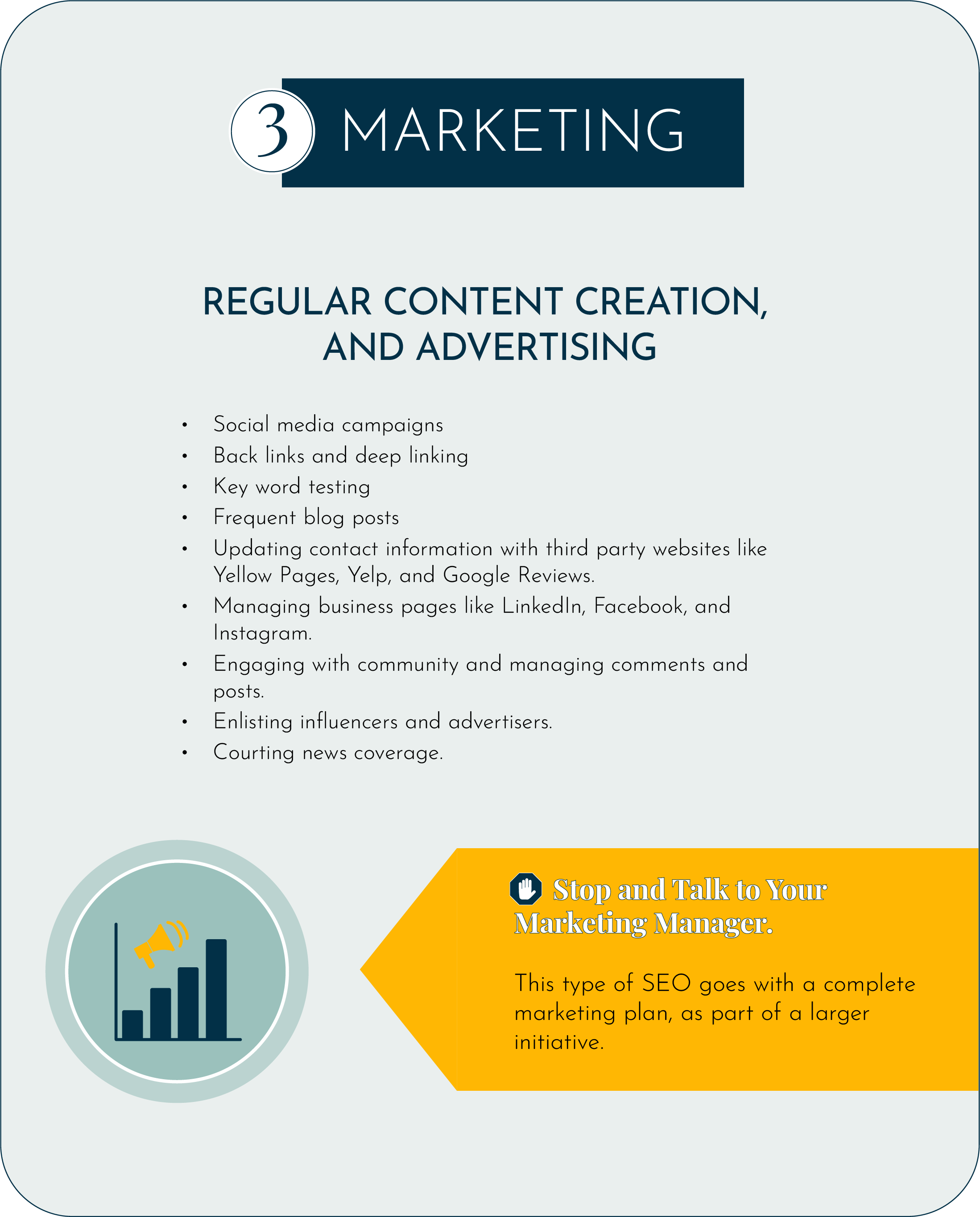
REGULAR CONTENT CREATION AND ADVERTISING
Social media campaigns. Back links and deep linking. Key word testing. Frequent blog posts. Updating contact information with third party websites like Yellow Pages, Yelp, and Google Reviews. Managing business pages like LinkedIn, Facebook, and Instagram. Engaging with community and managing comments and posts. Enlisting influencers and advertisers. Courting news coverage.
Stop and Talk to Your Marketing Manager. This type of SEO goes with a complete marketing plan, as part of a larger initiative.
This strategy often goes with social media campaigns, where social posts will link to a blog post, and that blog post will link to another blog post, which will point back to social media pages. This is referred to as “back links” and “deep linking,” and is a way to keep your users looped into your content, going from post-to-post, remaining in your ecosystem and discovering new content. You’ve experienced this loop yourself if you’ve watched a video short and then gone to a webpage explaining in more depth, and then to a longer video explanation. This strategy is routinely used by influencers and content creators.
This level of SEO can also include reaching out to contact websites like the Yellow Pages and Yelp to correct any information mistakes – an updated phone number, a new location – and managing business pages where you engage directly with customers, like Facebook, Instagram, YouTube, and LinkedIn. These pages are optimized with frequent posts and regular content moderation for comments and threads, as well as engaging with peer and partner businesses on their pages to encourage cross-posting and organic growth.
Engaging with influencers, setting advertisements, and any promoted news coverage included here will always boost SEO.
This level of SEO, I leave to specialists. Think of this like you would think of any other marketing effort. If you’re a business that leans into marketing and that’s part of your routine, consider SEO as a leg to your marketing strategy. But if you’re not engaging in marketing already, consider speaking with a marketing strategist before you speak to an SEO strategist. The jury is still out on how effective this type of effort is in isolation for established businesses – especially without the support of a planned and focused marketing strategy. Does boosting website views actually lead to conversions? For some businesses, these are very related. For other businesses, they burn a lot of energy (and a lot of dollars) on boosting website views, and see no boost in foot traffic or purchases. Website views are just website views. You need to evaluate the impact of these views on your business if you’re going to emphasize views as a business goal.
SEO and the Limits of Web Design
SEO as a term means a lot of different things, all of which ultimately are about boosting search rankings.
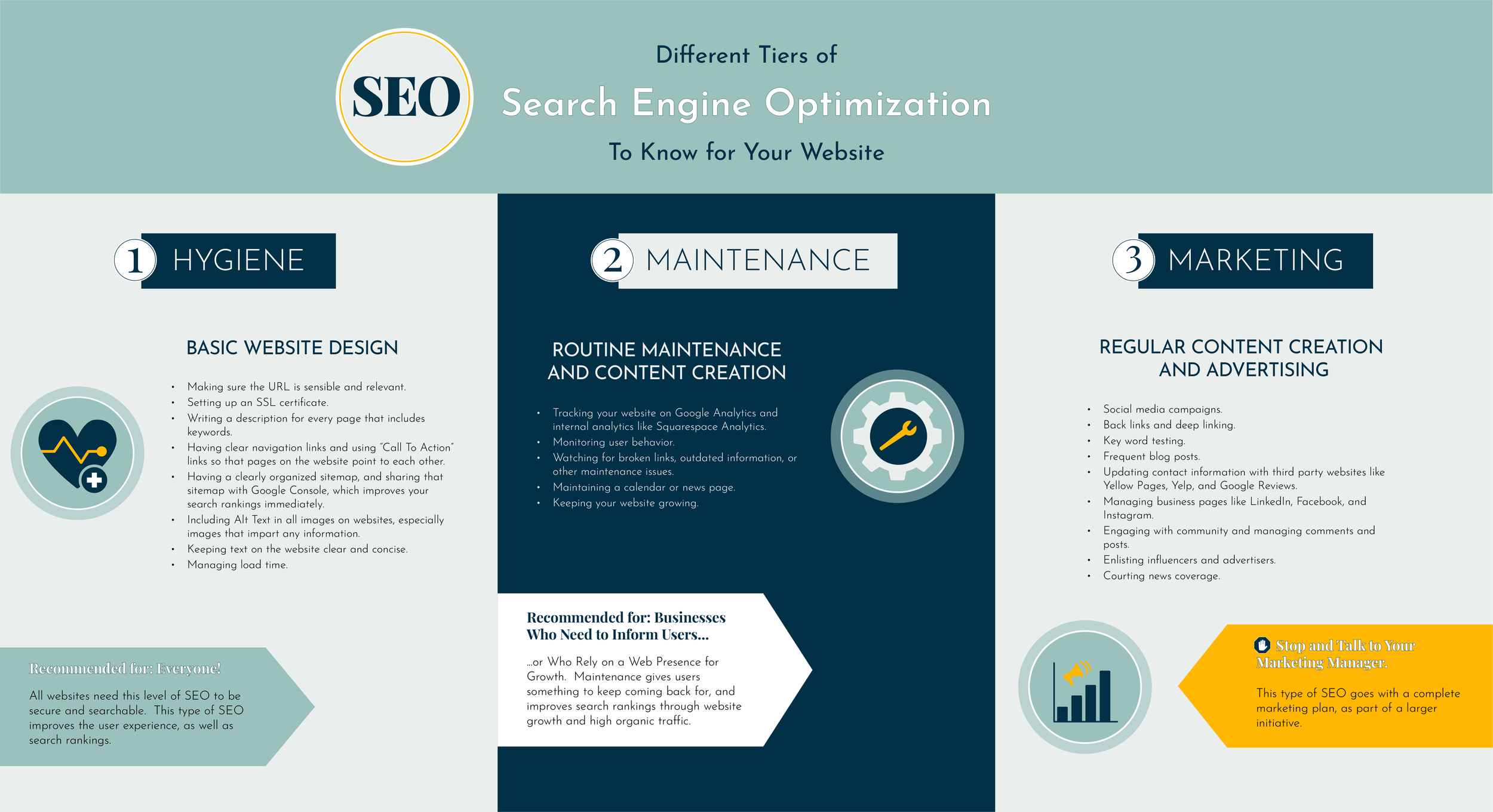
Different Tiers of Search Engine Optimization to Know for Your Website.
BASIC WEBSITE DESIGN
Making sure the URL is sensible and relevant. Making each slug is sensible and relevant. Setting up an SSL certificate. Writing a description for every page that includes keywords. Having clear navigation links and using “Call To Action” links so that pages on the website point to each other. Having a clearly organized sitemap, and sharing that sitemap with Google Console, which improves your search rankings immediately. Including Alt Text in all images on websites, especially images that impart any information. Keeping text on the website clear and concise. Managing load time.
Recommended for: Everyone! All websites need this level of SEO to be secure and searchable. This type of SEO improves the user experience, as well as search rankings.
ROUTINE MAINTENANCE AND CONTENT CREATION
Tracking your website on Google Analytics and internal analytics like Squarespace Analytics. Monitoring user behavior. Watching for broken links, outdated information, or other maintenance issues. Maintaining a calendar or news page. Keeping your website growing.
Recommended for: Businesses Who Need to Inform Users, or Who Rely on a Web Presence for Growth. Maintenance gives users something to keep coming back for, and improves search rankings through website growth and high organic traffic.
REGULAR CONTENT CREATION AND ADVERTISING
Social media campaigns. Back links and deep linking. Key word testing. Frequent blog posts. Updating contact information with third party websites like Yellow Pages, Yelp, and Google Reviews. Managing business pages like LinkedIn, Facebook, and Instagram. Engaging with community and managing comments and posts. Enlisting influencers and advertisers. Courting news coverage.
Stop and Talk to Your Marketing Manager. This type of SEO goes with a complete marketing plan, as part of a larger initiative.
Basic SEO is a real requirement to have a site that your users can use and find. This is really important.
Maintenance, I always recommend for businesses who connect with customers online. Getting that boost in discoverability can be great when you want to grow. For businesses where your website is an afterthought and you get all your customers from networking and word-of-mouth, this can be less critical.
Social Media Campaigns need a specialized touch, as this is a concerted effort, needing staff. I can help with pieces like hooking your social media to your website and designing templates for posts on Instagram and other social media sites. For the rest of it, you’ll need a specialized team.
If your business is considering this level of web presence, I would encourage you to work with a brand manager/marketing manager to decide where a heavy web presence fits into your business goals – and if it does at all. For businesses reliant on views for income, pushing into this type of marketing can make sense. For businesses that are selling a product online, it’s important to remember that views do not always mean conversions. There might be better places to put your dollars with a higher conversion rate. And for businesses who get clients through networking and relationships, this level of web presence might not align with your growth strategy.
I often remind clients to think of a website as train tracks – and only as train tracks. It directs traffic, but it’s not a complete picture. You need your own engine, your own customers, your own staff and management, your own strategy, and your own partners to be an effective business. The services I provide are here to help you achieve your goals, and if SEO sounds like just one more buzz word in the alphabet soup that is web design, know that I’m here to help unpick this for you.